Why AI Projects Demand a Hybrid Project Management Approach?
Artificial Intelligence (AI) projects have moved from experimental prototypes to mission-critical implementations that transform entire business operations. However, managing AI projects isn’t straightforward. Unlike traditional software development, AI projects involve uncertainty, iteration, and continuous learning—factors that make conventional methodologies insufficient on their own.
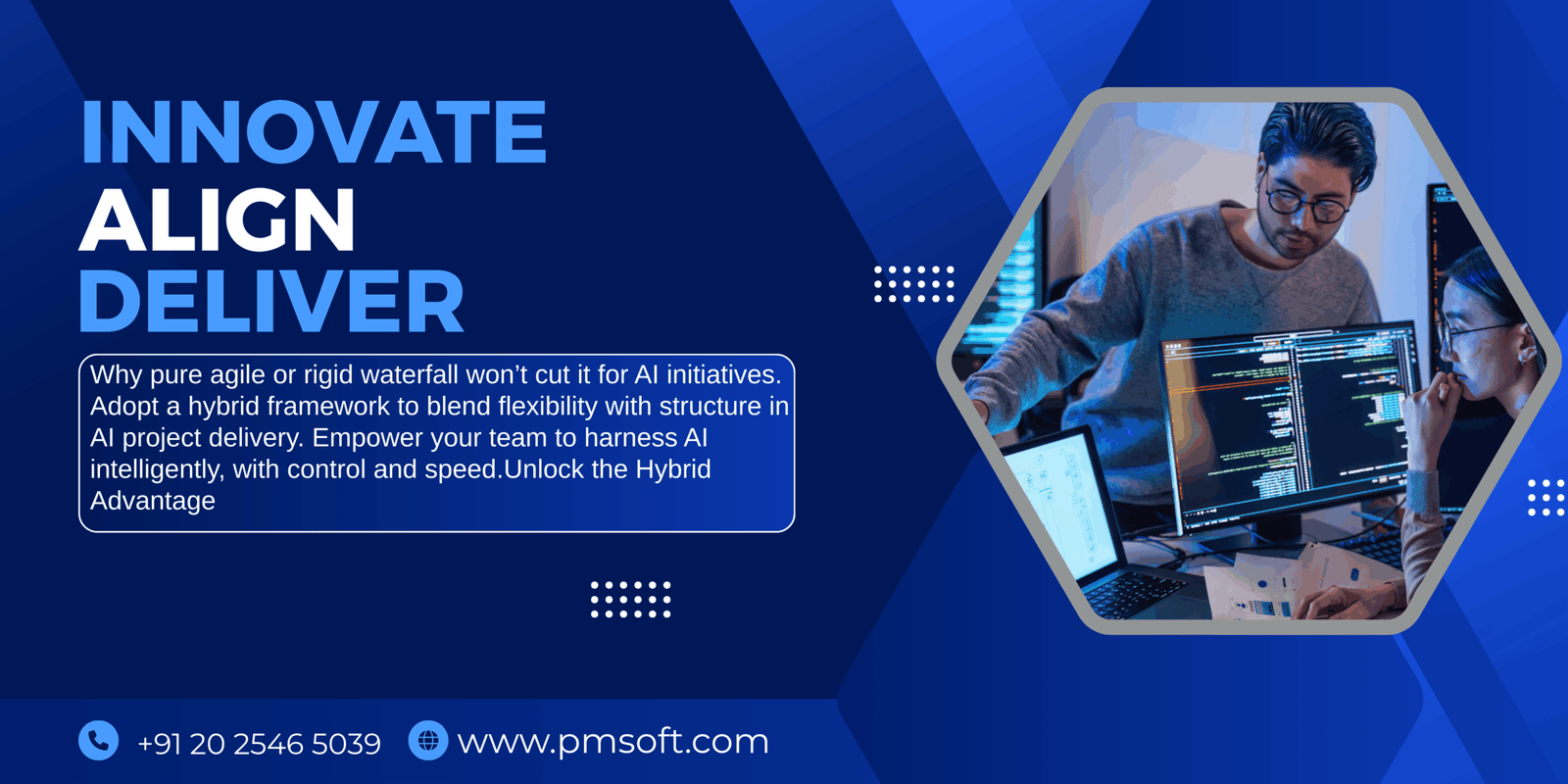
This is where Hybrid Project Management steps in. By combining the structured discipline of Waterfall with the flexibility of Agile, the hybrid model offers a balanced framework ideal for handling the complexities of AI initiatives.
Understanding AI Project Complexities
AI project management is not just about coding models—it involves data acquisition, model training, testing, and continuous iteration. Unique aspects include uncertain outcomes, iterative development, data dependency, cross-functional teams, and ethical/regulatory considerations.
What is Hybrid Project Management?
Hybrid Project Management combines the predictability of Waterfall with the adaptability of Agile. Strategic phases such as project initiation, data governance, and regulatory planning follow structured, sequential methods, while model training, validation, and continuous improvement occur through Agile sprints.
Why AI Projects Need a Hybrid Approach
1. Iterative Yet Goal-Oriented
Hybrid management allows teams to maintain strategic direction while executing flexible development cycles.
2. Managing Data Complexity
Data collection, cleaning, labeling, and validation need clear milestones and governance — strengths of the Waterfall model. Once pipelines are in place, Agile iterations handle model experimentation.
3. Cross-Functional Collaboration
AI projects involve data engineers, domain experts, ML specialists, and project managers. Hybrid models blend structured communication with frequent feedback loops.
4. Risk Management and Compliance
Waterfall-style documentation ensures compliance and audit readiness, while Agile’s iterative validation helps detect issues early.
5. Scalability and Continuous Learning
Hybrid project management supports post-deployment evolution through Agile monitoring cycles embedded within a long-term framework.
Aligning Hybrid Management with the AI Lifecycle
| AI Project Stage | Primary Approach |
|---|---|
| Problem Definition & Feasibility | Waterfall |
| Data Collection & Preprocessing | Waterfall |
| Model Development | Agile |
| Model Evaluation & Validation | Agile |
| Deployment & Integration | Waterfall + Agile |
| Maintenance & Improvement | Agile |
Benefits of the Hybrid Approach
Improved governance and accountability, faster time-to-market, enhanced decision-making through data feedback, flexibility without losing control, and effective resource utilization.
Conclusion
AI projects are dynamic, data-driven, and highly iterative—making them unsuitable for one-size-fits-all management approaches. The Hybrid Project Management model strikes the right balance between Agile flexibility and Waterfall discipline, enabling successful delivery of AI-driven initiatives.